Optimizing the Cart Journey
Driving Higher Checkout Conversion
CONTEXT
Nykaa Fashion is one of India’s leading fashion and lifestyle marketplaces, hosting 3,000+ brands across apparel, footwear, accessories, and home. The platform serves millions of shoppers across India, connecting a large base of high-intent users with both premium and emerging fashion labels.
At this scale, even small improvements in the Cart experience directly influence conversions, brand sales, and revenue across thousands of products and brands.
MY ROLE
Design Owner
I led the cart revamp across app and mobile web, working closely with the Deisgn Team, Researcher, Product, Engineering and Analytics team. My role was to create clarity around the problem, enable a more data-centric design approach, guide the team through research and prioritisation, and ensure that every solution was grounded in user behaviour rather than assumptions.
As the design lead, my focus was not just on the final UI. It was on building the right process for the team to arrive at stronger solutions.
I enabled the team to move from opinion-led design to evidence-led design. We used data to identify problem areas, user research to validate behaviour, and brainstorming sessions to explore solutions from multiple angles.
The team worked through:
Funnel analysis
User behaviour mapping
Cart interaction audits
Competitive benchmarking
Problem statement validation
Brainstorming workshops
Solution prioritisation
Prototyping and interaction design
Design reviews with PM and Engineering
QA and execution checks
Post-release tracking
My role was to keep the team focused on the real user problem, help them prioritise high-impact opportunities, and ensure that we shipped solutions that were both user-friendly and business-relevant.
DEEP DIVING INTO DATA
In collaboration with Product and the Analytics team, we deep-dived into funnel metrics, navigation flows, cart interactions, product removal behaviour, back-navigation triggers, and time spent on cart on Mixpanel. This data helped us uncover that users were not simply dropping off.
They were hesitating.
They were checking.
They were second-guessing.
They were looking for reassurance before committing.
That insight changed the direction of the project.
The cart was not failing because users lacked intent.
The cart was failing because it did not give users enough confidence to act on that intent.
Users were treating the cart like a temporary wishlist. They would add multiple products, compare options, go back to PDPs, check images, validate sizes, look for reviews, confirm return policies, and then either remove items or abandon the journey completely. The cart was forcing an all-or-nothing checkout decision when users were still in evaluation mode.
How might we make the cart feel safer, clearer, and more reassuring so users can move to checkout with confidence?
PROBLEMS WE IDENTIFIED
1. The cart did not support safe decision-making
The SKU cards were difficult to scan quickly. Primary and secondary actions were not clearly separated. Mistaps could remove products that users had spent time discovering. There was no confirmation before destructive actions. Basic changes like size and quantity pushed users back to the PDP.
2. Intent was leading backward
Around 72% of users were navigating from Cart to PDP. This was not just a navigation pattern. It was a signal.
Users were going back because they needed reassurance. They wanted to zoom into images, check product details, validate ratings and reviews, understand return policies, or simply feel more certain before making a purchase.
3. Lack of important information
The cart did not provide enough decision-supporting information. Users had to leave the cart to zoom into product images, check highlights, validate reviews, confirm return policies, or revisit product details.
This context switching broke purchase momentum.
4. Out-of-stock handling created anxiety
Out-of-stock items were scattered among active SKUs. Availability status was not immediately clear. Users had to manually resolve blockers before moving forward.
This made the cart feel messy and unreliable, especially when users had multiple products added.
5. The cart amplified commitment anxiety
Users were adding multiple products, comparing them, removing some, saving some, and abandoning others. But the cart treated every user as if they were ready for a full checkout.
There was no flexibility for partial commitment.
The cart was asking for a final decision before users were emotionally ready to make one.
EXECUTION IN PHASES
PHASE 1 - FIXING THE FOUNDATION
The first step was not to add new features. It was to reduce friction and make the cart easier to understand at a glance.
I guided the team to focus on foundational clarity before moving into more advanced interventions. Through brainstorming sessions, design critiques, data reviews, and stakeholder discussions, we aligned on a principle:
Make every SKU easier to evaluate, edit, save, or resolve without leaving the cart.
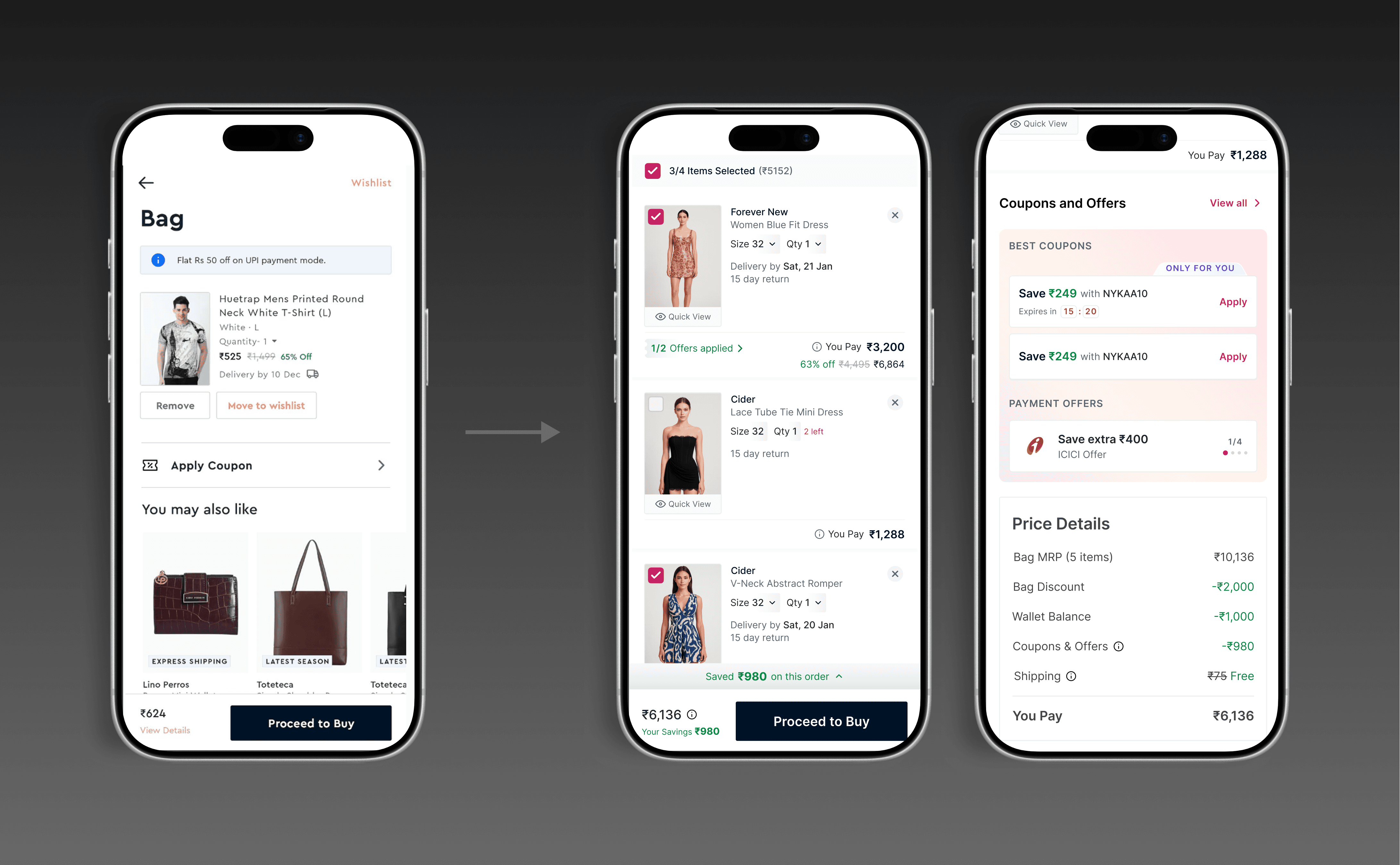
We redesigned the SKU card to improve scanability and decision-making. The new structure created clearer hierarchy between product information, price, offers, size, quantity, delivery information, and actions.
We separated primary and secondary actions more clearly. We added confirmation before removal to prevent accidental destructive actions. We simplified size and quantity edits so users did not have to go back to PDPs for basic changes. We surfaced intent-building nudges like price drops. We grouped out-of-stock products together so users could resolve blockers faster.
Before adding delight, we had to remove doubt.
Key improvements
Clearer SKU card hierarchy
Improved product scanability
Safer removal pattern with confirmation
Easier size and quantity edits
Better visibility of price drops and nudges
Grouped out-of-stock items for faster resolution
Cleaner separation of active and blocked items
Impact
+3.85% increase in wishlist additions
+2.6% increase in Cart View → Order
3% decrease in product removals
This phase helped us solve for clarity, control, and anxiety around cart actions.
PHASE 2 - PRESERVING MOMENTUM WITH QUICK VIEW
We did not assume that shipping the redesign meant the problem was solved. I encouraged the team to treat the release as a learning milestone and revisit funnel behaviour. The post-release data showed that users were still moving from Cart to PDP. The volume reduced in some areas, but the behaviour persisted.
So we dug deeper.
We analysed navigation paths, interaction patterns, and the reasons users were returning to product pages. The drivers became clear: users wanted image zoom, product details, ratings and reviews, and return validation.
At this point, the opportunity was obvious.
Instead of forcing users to go back to the PDP, we could bring reassurance into the cart.
We stopped treating PDP navigation as a drop-off and started treating it as a request for confidence.
That led to Quick View
Quick View began as a lightweight intervention that allowed users to access key product information without leaving the cart. Over time, it evolved into a richer reassurance layer, helping users validate their choices while staying in the purchase flow. It helped to solve -
Reduced unnecessary PDP back-navigation
Preserved cart momentum
Helped users verify product details in context
Supported image zoom and product reassurance
Reduced decision anxiety before checkout
Impact
70% to 55% reduction in drop off from Cart to Product Detail Page.
PHASE 3 - IMPROVING COUPON EXPERIENCE
The next major friction point was savings. Coupons and offers were fragmented across the journey. Users had to understand which coupon applied, which offer gave the best value, whether the coupon could be combined with another offer, and whether they were missing out on better savings. This created cognitive load at a very sensitive moment. At checkout, users should not have to solve a discount puzzle.
Savings should feel discovered, not decoded.
We reframed the coupon experience from manual coupon selection to guided savings. The idea was to help the platform identify the best possible combination of offers and guide users step by step. The new direction focused on making savings clearer, reducing effort, and building trust that the user was getting the best available deal.
Move from coupon discovery to guided savings
Make best offers easier to understand
Reduce cognitive load around discount rules
Help users apply relevant offers step by step
Build trust through clarity and transparency
This shifted the experience from “Which coupon should I use?” to “Nykaa is helping me get the best deal.”
FINAL PHASE - ENABLING PARTIAL CHECKOUT
One of the strongest behavioural insights was that users did not always want to buy everything in the cart at once.
They were curating. Comparing. Saving. Removing. Reconsidering.
But the cart experience expected a single decision: checkout everything or abandon.
This created commitment anxiety.
Not every cart is a checkout cart. Sometimes, it is a decision board.
To solve this, we explored Partial Checkout as a way to give users more flexibility and control. Instead of forcing users to act on the entire cart, we allowed them to move forward with the items they were ready to buy while keeping the rest for later.
This was an important shift in how we understood cart behaviour.
The goal was not just to increase checkout. The goal was to respect the user’s decision state and reduce the pressure of full commitment.
What Partial Checkout solved
Reduced all-or-nothing pressure
Helped users move forward with high-confidence items
Reduced abandonment caused by undecided products
Supported real shopping behaviour
Improved flexibility during high-consideration purchases
Impact
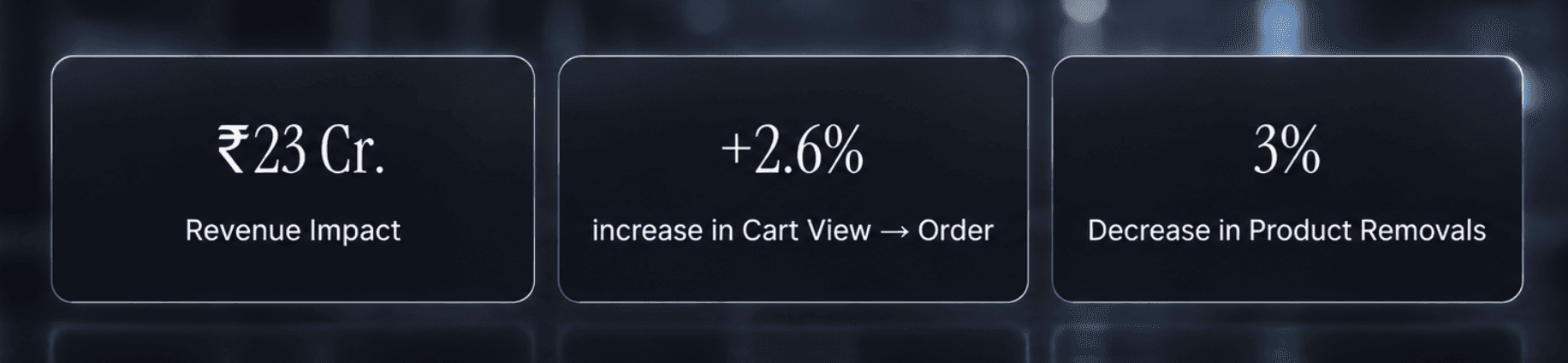
₹23 Cr revenue impact
+2.6% increase in Cart View → Order
3% decrease in product removals
FINAL REFLECTION
This project reinforced an important design leadership lesson for me:
High-impact product design is not always about creating something new. Sometimes, it is about identifying where confidence breaks and quietly rebuilding the experience around trust, clarity, and control.
For Nykaa Fashion, the cart was one of those moments.
Users already had intent.
Our job was to protect it.